
2700K vs 3000K Outdoor Lighting: Which Is Better?
Choosing solar pathway lights? The 2700K vs 3000K outdoor lighting decision can change the look and feel of your yard after dark. Both are warm-white options, but they serve slightly different goals.
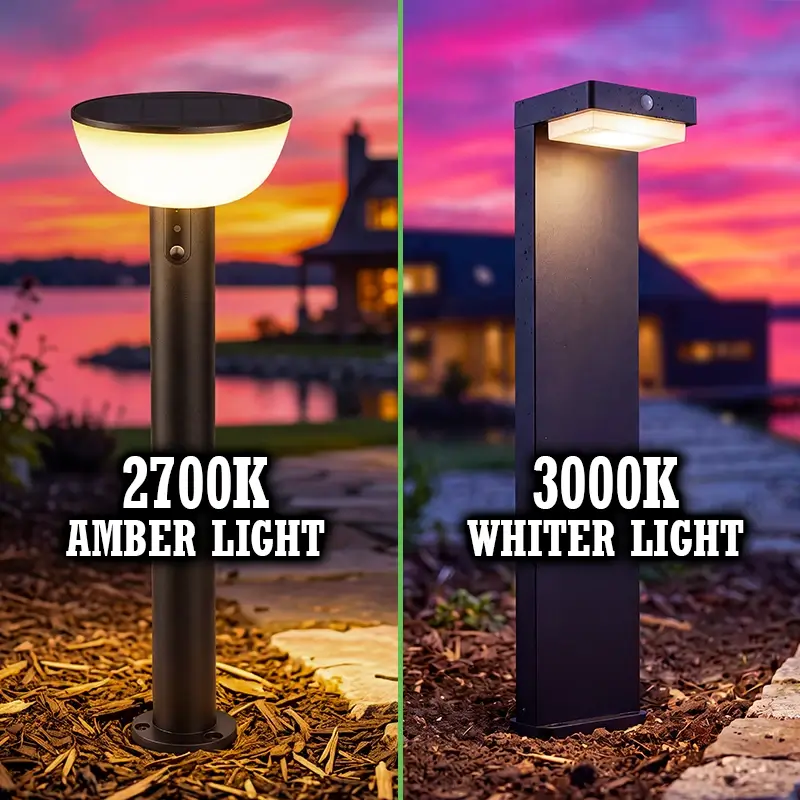
Quick answer: Choose 2700K for a softer, cozier glow around gardens and patios. Choose 3000K for a crisper warm white along frequently used walkways, entrances, and steps.
What is the difference?
“K” stands for Kelvin, which describes the color of light. At 2700K, light looks warm with subtle amber tones. At 3000K, it looks a little whiter while remaining warm and inviting.
Kelvin does not measure brightness. A 3000K fixture is not necessarily brighter than a 2700K fixture. Check the lumens and where the light falls if your goal is to see a path clearly.
| 2700K | 3000K | |
|---|---|---|
| Look | Soft, warm white | Cleaner warm white |
| Best use | Gardens, patios, quiet paths | Main walkways, steps, entrances |
| Feel | Cozy and relaxed | Crisp and welcoming |
2700K vs 3000K for gardens: Why choose 2700K?
2700K solar landscape lights add a gentle glow without making a yard feel overly bright. They are a natural fit for garden borders, seating areas, porches, and paths where ambiance matters as much as navigation. VerLuce’s Basin and Victorian solar pathway lights use 2700K.
For homeowners concerned about wildlife and the night sky, 2700K is generally the better starting point in the 2700K vs 3000K comparison. Compared with a similar 3000K white LED, it typically has less short-wavelength blue light. DarkSky International recommends 2700K or lower for its most night-friendly home outdoor lighting guidance.
2700K vs 3000K for walkways: Why choose 3000K?
3000K solar pathway lights have a slightly whiter appearance that can help define the route along a busy front walk or driveway edge. Consider this color for entrances, turns, and steps where you prefer a clearer-looking warm white. VerLuce’s Courtyard and Barn solar pathway lights use 3000K.
For dependable walkway visibility, look beyond color temperature. Choose enough lumens for the area, space the lights so the path is easy to follow, and avoid glare. Well-placed 2700K lights can illuminate a walkway more effectively than poorly placed 3000K lights.
Which is better for your yard?
Pick 2700K if you want a soft, inviting landscape and less blue-rich light. Pick 3000K if you want a crisper look on a route people use often. You can also use 2700K around a patio or garden and 3000K along the main path, provided the colors work with your existing outdoor lighting.
Whichever you choose, direct light toward the ground, use the lowest useful brightness, and use motion settings where available. Color temperature helps set the mood; thoughtful placement makes the lighting useful and limits light spill into the sky or surrounding habitat.
Explore VerLuce solar pathway and landscape lights to find the right color and style for your outdoor space.