
Solar vs. Low-Voltage Landscape Lighting: Which Is Right for Your Pathway?
Pathway lighting is one of the most practical upgrades you can make to an outdoor space. It guides guests safely to your door, reduces trip hazards after dark, and highlights the plants and hardscaping that make a yard feel finished. The two most common options are solar and low-voltage wired lighting. Both can look great, but the solar vs. low-voltage decision comes down to how each is installed, powered and maintained.
How Low-Voltage Landscape Lighting Works
A low-voltage system starts with a transformer, which plugs into an outdoor outlet and reduces standard 120-volt household current to about 12 volts. A main cable runs from the transformer through the yard, and each fixture connects to it. The cable is usually buried a few inches underground.
Because the lights draw from your home’s electricity, they deliver steady output every night, regardless of weather. That reliability comes with more upfront work: planning the layout, sizing the transformer, digging trenches and making weatherproof connections. Many homeowners hire a professional, and once the cable is buried, moving a fixture means digging it up again.
How Solar Pathway Lights Work
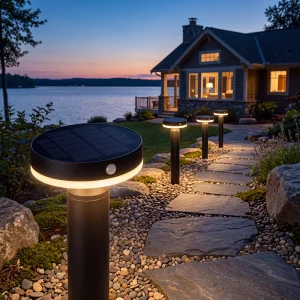
Each solar light is a self-contained unit. A small panel on top charges a rechargeable battery during the day, and a built-in light sensor turns the LED on at dusk. No transformer, cable or outlet is required.
Installation is usually as simple as pressing a stake into the ground. If you redesign a garden bed, just pull the light and move it.
Early solar lights earned a reputation for dim, short-lived output, but modern fixtures with efficient mono-crystalline panels, lithium-ion batteries and warm, high-CRI (color accuracy) LEDs now produce light much closer to wired fixtures.
Solar vs. Low-Voltage: Installation and Maintenance
- Installation: Low-voltage requires planning, trenching and wiring. Solar takes minutes per light, with no tools.
- Ongoing cost: Low-voltage adds to your electric bill. Solar runs on free sunlight.
- Maintenance: Low-voltage connections and buried cable need periodic checks. Solar lights need an occasional panel wipe and a battery replacement every few years.
- Flexibility: Low-voltage fixtures are tied to the cable route. Solar lights can be re-positioned anytime.
- Performance: Low-voltage is more consistent in heavy shade or long cloudy stretches. Solar performs best with several hours of direct sun.
Solar vs. Low-Voltage: Which Should You Choose?
Low-voltage remains a good choice for heavily shaded yards or powerful accent lighting on trees and architecture. For most pathways, walkways and garden borders, though, solar is the simplest route: no wiring, no electrician, no added energy use and very little upkeep. For best results, place solar lights where they’ll get six to eight hours of direct sun.
Lighting Your Path with VerLuce
If the solar vs. low-voltage comparison points you toward solar, VerLuce solar pathway lights pair that easy setup with premium performance: 95+ CRI, warm 2200K–3000K light, 35 to 55 hours of runtime per charge, USB-C backup charging for shady spots and a 2-year warranty. Explore the VerLuce solar pathway light collection to find a style that fits your home.